Authors: Ayman Khalil & Romain Muguet
Why EUCC certification increasingly depends on what happens after the certification ends
European cybersecurity certification is shifting toward operational concerns. Previously, discussions centered on frameworks, recognition, and regulatory alignment. While this initial certification is now well-established, attention is increasingly focused on the subsequent phase: ensuring sustained confidence in certified Information and Communications Technology (ICT) products after their deployment. This involves critical aspects like product maintenance, vulnerability management, and reassessment.
As EUCC implementation advances, organisations more and more recognise that obtaining a certificate is only one step in the larger security journey. And operational challenges often arise after certification approval. Hereafter are typical use cases that need to be handled:
- A vulnerability may affect a third-party cryptographic component months after certification.
- A firmware update may become necessary to address an emerging attack technique.
- A hardware component can reach the end of its life and necessitate replacement within a product line.
- A security patch may change the behavior of the evaluated product under a specific configuration.
The encouraging news is that these use cases do not automatically result in the product’s certification being revoked, contrary to initial concerns. However, such operational challenges can no longer be disregarded. And most of all, it does not diminish the value of certification. Instead, this situation highlights efforts to strengthen long-term confidence in certified ICT products across Europe.
This additional aspect of product security needs to be taken into account in the certification for the main reason that products rarely remain static after their certification. This is due to their evolving operational demands, security updates, new threats or even a possible supply chain change. So the EUCC scheme relies on specific assurance activities for defined products, configurations and their intended assumptions. And most organisations who are freshly tackling EUCC, tend to underestimate the ongoing coordination required after the certificate award phase. Certification is often seen as the project endpoint, while in practice it marks the beginning of a life-cycle commitment.
What EUCC Certification Confirms
A common misconception is that certification guarantees a product’s permanent security. In reality, it provides a precise and valuable assurance, one that confirms the product meets defined security requirements within a specific scope, under explicit assumptions, and only covers vulnerabilities that were known at the time of the evaluation.
As you might already know the evaluation process is based on an identified Target of Evaluation supported by technical documentation and operating conditions. This process is intentionally rigorous, encompassing documentation reviews, functional testing, and vulnerability assessments to validate security functions. The depth of analysis and overall activities varies depending on the assurance level, evaluation scope, and the nature of the product. This rigour is critical: if certification were reduced to an administrative formality, its value would diminish. Assurance conclusions are tied to the product’s state at the time of assessment, including its certified configurations, evaluated interfaces, and operational assumptions.
However, and as mentioned previously, products do not remain static post-certification. EUCC and its guidance smartly acknowledge that products must evolve, mainly driven by cybersecurity reasons. This is where maintenance and assurance continuity processes were established. They exist precisely because ICT products should not remain unchanged indefinitely, and changes in the product should not necessarily require a new full reassessment if managed correctly.
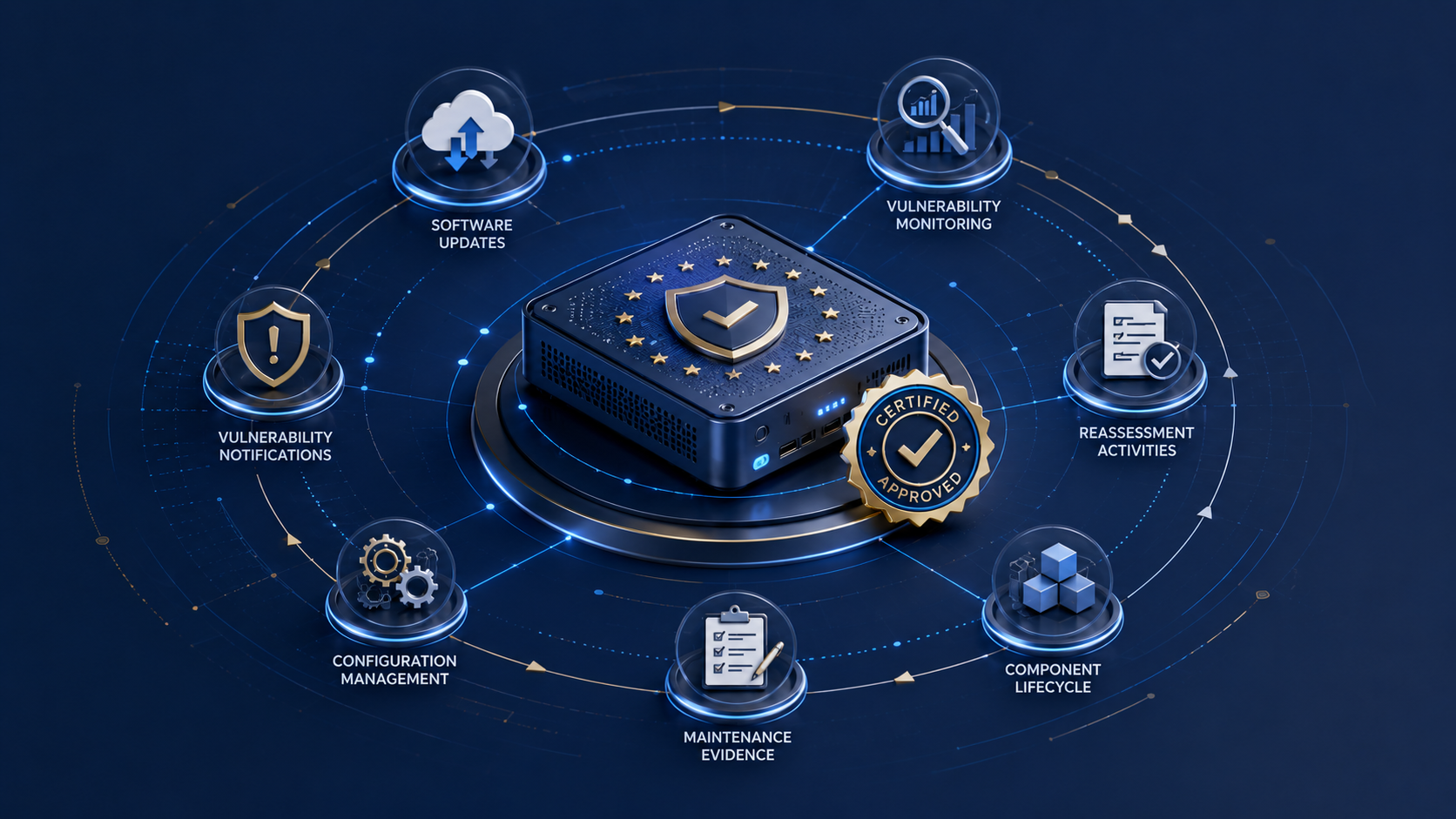
The subtlety lies in understanding that certification confirms a product meets defined assurance levels under evaluated conditions. Sustaining confidence demands an awareness of how changes impact those original assumptions. For organisations new to EUCC certification, this shift may seem unexpected. Ongoing vulnerability monitoring, patch analysis, configuration control, and maintenance evidence become essential to maintaining assurance. Far from being a weakness, this evolution reflects a realistic recognition of how modern ICT products operate in dynamic security environments.
What Changes After Certification
Viewing certification as a fixed milestone becomes challenging once products enter operational use. Modern ICT products evolve frequently, driven by emerging vulnerabilities in embedded third-party softwares, software updates, shifting hardware dependencies, or even business demands. From a security standpoint, this evolution is not only normal but often necessary.
From an assurance perspective, however, a key question arises: how much change is acceptable before the original certification assumptions must be revisited? This question lies at the heart of many post-certification discussions under EUCC.
The following examples only scratch the surface of the operational considerations organisations face after certification but give a good idea of what awaits them.
| Third-Party Components | Changes to third-party software or libraries can invalidate original certification assumptions. For example a vulnerability in a third-party component (e.g., a cryptographic library) may require patching. While the update itself might be straightforward. It could be as “simple” as changing the library’s version or choosing another cryptographic library for example. It is the impact on the original evaluation, such as changes to entropy generation, protocol handling, or key management, that can demand extensive re-analysis to confirm that core assurance conclusions still remain valid. |
| Firmware Maintenance | Security updates to firmware may seem minor but can affect critical assumptions. Updates that modify trusted boot processes, update integrity mechanisms, or evaluated interfaces often require further analysis to ensure alignment with the original certification scope. |
| Operational Security | Operational agility must be balanced with assurance continuity. Teams often underestimate the effort required to assess how changes, such as patching vulnerabilities or adjusting security configurations, affect the original security rationale. The challenge lies not in implementing changes but in understanding their impact on the certification’s foundational assumptions. |
| Product Families and Series | Variants within a product family can introduce subtle but significant differences. Manufacturers may maintain related products built on shared architectures but tailored to different requirements. Even minor differences in firmware, hardware, or security features can create new assurance considerations, leading to a growing gap between the certified and deployed product. |
| Additional Features | Modifications that can seem minor but actually expand the attack surface. Adding remote management interfaces, enabling automatic updates, or introducing new administrative features may seem inconsequential but can easily introduce new risks, even if core functionalities remain unchanged. |
The ENISA guidance on evaluation methodologies for product series reflects this reality.1 Developers may need to produce Differential Analysis Reports to explain how products differ and why testing results can still be reused across the series. Additional evaluation activities may be necessary when differences begin to affect security-relevant behaviour or lifecycle assumptions.
This becomes especially relevant as organisations scale their product portfolios. Maintaining assurance for a single evaluated product is already demanding; preserving consistency across evolving variants requires even greater coordination among developers, security experts, evaluators, and certifiers.
Supply chain changes add another layer of complexity. Hardware may reach end-of-life, suppliers may alter their processes, or alternative components may be integrated. Some changes have limited security impact, while others may affect core security functions or lifecycle controls, necessitating further analysis.
These situations do not imply certification is ineffective. Instead, they point out the importance of assurance continuity in upholding trust as products evolve during its lifecycle.

Certification Is Becoming a Lifecycle Commitment
The growing focus around EUCC reflects a broader shift in how cybersecurity assurance is being understood across the European ecosystem, perhaps even outside of Europe. Certification is no longer seen merely as a one-time technical validation. Instead, it is increasingly tied to an organisation’s ability to sustain trust as products evolve post-approval as detailed previously.
This evolution does not diminish certification’s value. On the opposite. What it actually does is put forward what was left in the shadows for far too long. Therefore enhancing the certification’s value.
The evaluation process remains the critical foundation for establishing confidence in ICT products. Rigorous testing, vulnerability assessments, documentation reviews, and assurance activities continue to demonstrate that security claims are credible and independently verified.
What is changing is the recognition that modern products do not remain operationally static once they enter the market. Vulnerabilities emerge. Components evolve. Product variants expand. Security updates become necessary. Threat intelligence shifts. The context surrounding certified products keeps moving long after the original evaluation activities have been completed.
The EUCC now formally recognises the importance of vulnerability handling, assurance continuity, maintenance, and reassessment. While many organisations likely already had these processes in place, the EUCC establishes standardised, mandatory procedures for all. Thus leveling the playing field. This ensures that even newcomers can adopt a more mature and sustainable approach to certification, regardless of their size.
This shift will likely grow in importance as organisations navigate the increasing interplay between EUCC certification and broader European cybersecurity requirements, such as the Cyber Resilience Act. The most effective organisations will be those that embed assurance thinking directly into product lifecycle management, rather than treating certification as a one-off regulatory exercise.
EUCC certification establishes a strong foundation of trust. However, maintaining that trust increasingly depends on how organisations manage security after the evaluation is complete.


- European Union Agency for Cybersecurity, “EUCC Guidelines: Evaluation Methodology for Product Series,” European Union Cybersecurity Certification, July 9, 2025, accessed May 21, 2026, https://certification.enisa.europa.eu/publications/eucc-guidelines-evaluation-methodology-product-series_en. ↩︎






Leave a Reply