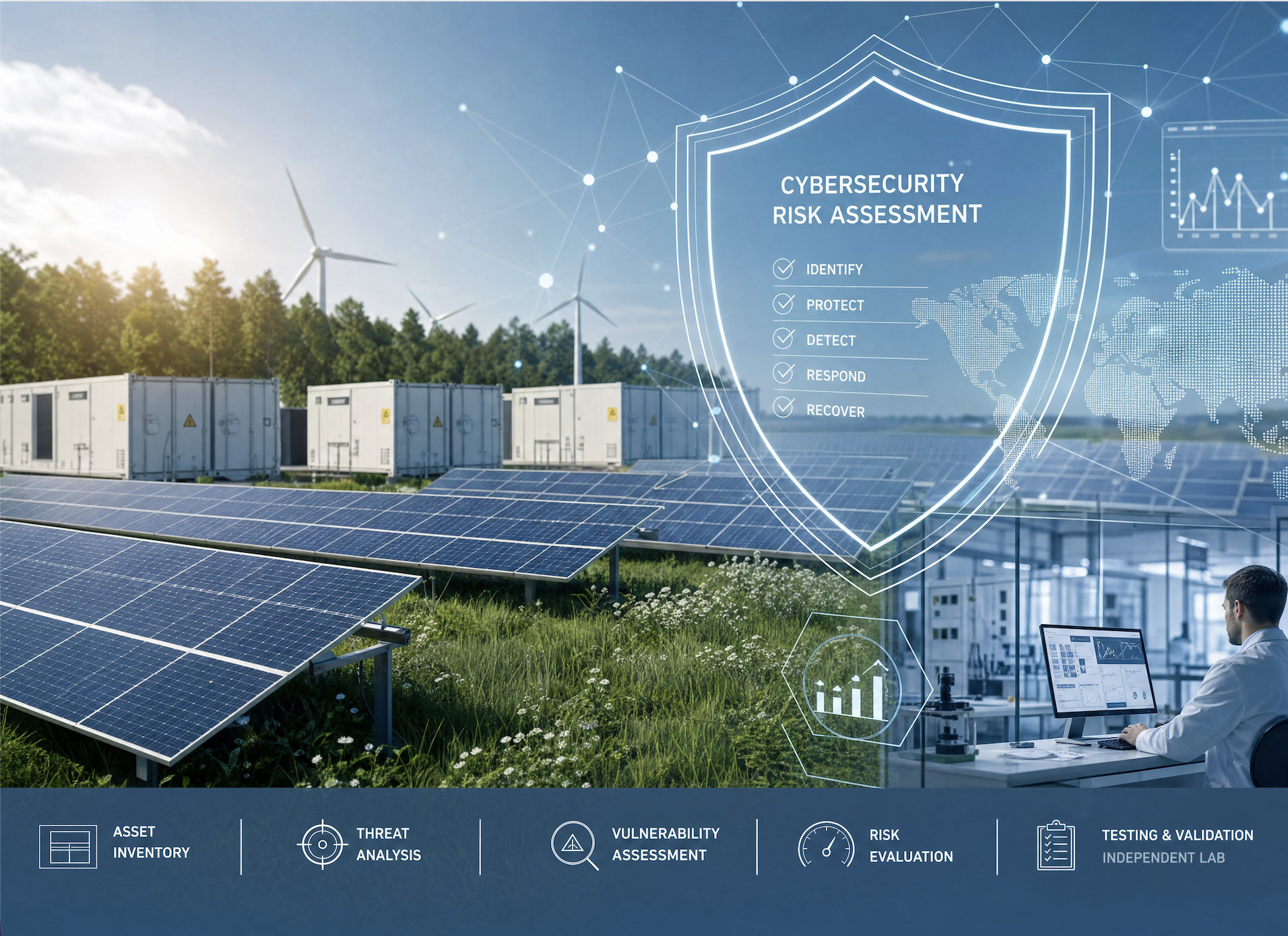
The energy sector is changing quickly. Solar plants, battery energy storage systems, hybrid renewable projects, grid-connected inverters, monitoring gateways, energy management platforms, and cloud-connected maintenance tools are now part of critical digital infrastructure.
What used to be mostly electrical engineering is now also software engineering, communications engineering, and cybersecurity engineering.
This shift is creating a real and legitimate concern: how should cybersecurity risk be understood when digital products become part of the energy system?
At recent industry discussions, many companies raised the same concern. They had heard references to “high-risk” products, suppliers, or countries, but could not find a clear technical explanation of what that meant in practice. Some could not identify the public source. Others were unsure whether “high risk” referred to a product vulnerability, a supplier process issue, a missing certification, an insecure architecture, an operational exposure, or simply a broad label.
In cybersecurity, “risk” is not a political shortcut or a procurement label. It is a technical judgment based on assets, threats, vulnerabilities, impact, likelihood, controls, testing evidence, and recognised standards.
A cybersecurity risk is not supposed to be a vague label. It is not a rumor. It is not a private discussion. It is not a shortcut for avoiding technical analysis. Risk is a structured concept, and if it is used in relation to energy infrastructure, it should be assessed in a structured way.
A cybersecurity risk assessment should answer specific questions:
- What asset is being protected?
- What threat scenarios are realistic?
- What vulnerabilities are present?
- What would the impact be if those vulnerabilities were exploited?
- How likely is exploitation under defined conditions?
- What controls address the risk?
- What evidence proves those controls are effective?
- Who performed the assessment?
- Against which standard?
- Under which scope and assumptions?
Without those answers, the word “risk” becomes too broad to guide engineering, procurement, certification, or investment decisions. Worse, it can create uncertainty across the market. In an industry that depends on long-term project financing, supply chain planning, and technical trust, uncertainty can become damaging even before any actual cybersecurity incident occurs.
Cybersecurity risk is technical, not symbolic
A cybersecurity risk is usually understood as the combination of a threat, a vulnerability, and an impact.1 A product may be exposed to threats because it communicates over networks, receives remote commands, processes credentials, stores configuration data, performs firmware updates, or connects to cloud platforms. It may contain vulnerabilities because of weak authentication, insecure update mechanisms, poor cryptographic design, insufficient logging, exposed debug interfaces, outdated third-party components, unsafe default configurations, or poor lifecycle maintenance.
But none of this can be determined by a label alone.
A grid-connected inverter, for example, may have very different cybersecurity properties depending on its architecture. One product may support secure boot, signed firmware updates, role-based access control, encrypted communication, secure key storage, vulnerability disclosure procedures, long-term patch support, and detailed audit logging. Another product in the same category may lack several of those controls. From a technical perspective, treating both products as identical would be wrong.
The same is true in the opposite direction. A product should not be assumed secure just because it comes from a familiar region, a known brand, or an established supplier. Cybersecurity is not inherited by geography or reputation. It is demonstrated by design, implementation, process maturity, vulnerability handling, testing, certification, and operational controls.
This is why standards matter. Standards force risk discussions to become concrete. They define requirements, evaluation methods, assurance levels, documentation expectations, lifecycle obligations, and testable security properties. They do not eliminate judgement, but they discipline it.
The difference between “risk-based” and “label-based” thinking
A risk-based approach begins with context. It asks what the product does, where it is deployed, what it connects to, what privileges it has, and what failure modes matter.
For energy infrastructure, the context is especially important. A small residential inverter, a utility-scale plant controller, a battery energy storage system, and a remote monitoring gateway do not carry the same risk profile. Their exposure, operational role, network position, safety implications, and potential grid impact differ.
A proper assessment must therefore consider the real deployment environment. Is the product directly reachable from the internet? Is it segmented behind a secure gateway? Can it receive remote commands? Does it interact with grid control functions? Can firmware be updated remotely? Are updates authenticated and integrity-protected? Can a compromised component affect availability, safety, power quality, or wider grid stability? Are credentials unique? Are logs available for incident response? Is there a coordinated vulnerability disclosure process? Are security updates provided for the expected product lifetime?
These are technical questions. They can be answered through documentation review, architecture analysis, source code review where applicable, penetration testing, protocol analysis, firmware analysis, configuration review, and conformity assessment.
A label-based approach works differently. It begins with a category and treats the category as the conclusion. That may be administratively simple, but it is not a cybersecurity assessment. A label may identify a reason for closer scrutiny, but it should not replace scrutiny itself.
If a product is considered risky, the technical basis should be explainable. The evidence should be inspectable by competent authorities or accredited bodies. The requirements should be traceable to recognised standards. The assessment should be traceable enough that another qualified evaluator can understand how the conclusion was reached.
Otherwise, companies are left with ambiguity. Ambiguity is bad for security because it does not tell engineers what to fix. It is bad for procurement because it does not tell buyers what to require. It is bad for manufacturers because it does not tell them what evidence to produce. It is bad for investors because it creates uncertainty without a technical path to resolution.
Recognised standards provide a better path
Europe already has a strong foundation for a standards-based approach to product cybersecurity.
The Cyber Resilience Act2, or CRA, creates mandatory cybersecurity requirements for products with digital elements placed on the EU market. Its purpose is to improve the security of hardware and software products throughout their lifecycle. It addresses secure design, vulnerability handling, security updates, documentation, and conformity obligations. The CRA also recognises that some products of particular cybersecurity relevance may require third-party conformity assessment before being placed on the market.3
This is important because it moves the discussion from general concern to concrete requirements. Manufacturers must be able to show that products are designed, developed, and maintained with cybersecurity in mind. They must handle vulnerabilities. They must provide security-relevant information. They must support users in deploying products securely. Compliance is not merely a marketing claim; it is tied to obligations and market surveillance.
For industrial and operational technology environments, IEC 624434 is another central reference. The IEC 62443 series5 addresses cybersecurity for industrial automation and control systems, with document 3-2 that focuses on Security Risk Assessment for system design. It is widely used to structure security requirements for components, systems, development processes, and operational environments. In energy infrastructure, where products interact with physical processes and long-lived assets, IEC 62443 is especially relevant because it recognises that security is not just a software feature. It is part of system architecture, lifecycle management, supplier processes, access control, network segmentation, incident response, and maintenance.
IEC 62443 also helps clarify a frequent misunderstanding: a product cannot be judged only in isolation. Component security matters, but so does how the component is integrated into a system. The same device may present different residual risks depending on whether it is deployed in a flat network or a segmented one, whether remote access is controlled, whether logs are monitored, whether updates are managed, and whether operators follow secure procedures.
For radio equipment and connected devices, the EN 18031 series6 is also relevant. It supports cybersecurity requirements linked to radio equipment, including network protection, privacy and personal data protection, and fraud protection. While the applicability depends on product type and scope, the broader lesson is the same: cybersecurity claims should be mapped to recognised requirements and assessed through defined methods.
Together, these frameworks point towards a mature principle: product security should be evaluated through transparent requirements and competent assessment, not inferred from informal categories.
Independent testing matters because trust needs evidence

Disclaimer: This image is AI-generated and provided for illustrative purposes only. The content depicted herein does not constitute factual representation, professional advice, or verified technical data. Readers should rely on the article’s core analysis for technical conclusions.
In cybersecurity, trust is not a slogan. Trust is built through evidence.
For energy products, that evidence may include secure architecture documentation, threat modelling, software bill of materials where appropriate, vulnerability management procedures, penetration test reports, firmware security analysis, cryptographic design review, secure update validation, access control testing, protocol security testing, supply chain controls, and lifecycle support commitments.
Independent testing has a specific role here. Manufacturers can and should perform internal security engineering, but independent laboratories and national certification or testing institutions provide external assurance. They help reduce conflicts of interest. They apply defined evaluation methods. They can verify whether claims are supported by evidence. They can test whether controls actually work.
This is particularly important for critical sectors. A product may claim to support secure updates. Still, testing should verify whether update packages are signed, whether signature verification is correctly implemented, whether downgrade attacks are prevented, whether keys are protected, whether recovery mechanisms are safe, and whether update failure modes are controlled. A product may claim encrypted communication, but testing should verify protocol choices, certificate validation, key exchange, cipher configuration, credential storage, and resistance to interception or impersonation. A product may claim access control, but testing should verify role separation, password policy, session management, brute-force resistance, default accounts, local interfaces, APIs, and privilege escalation paths.
This is where labels fall short. A label cannot tell an operator whether debug services are exposed. It cannot tell an investor whether the update mechanism is robust. It cannot tell a grid operator whether remote commands are authenticated. It cannot tell a certification body whether the supplier’s vulnerability handling process is mature. Only a technical assessment can do that.
Risk assessment must be scoped and proportionate
A good technical risk assessment needs to be scoped.7
Scope defines what is being assessed. Is the assessment about one device model, one firmware version, one cloud service, one deployment architecture, one supplier development process, or one complete energy system? Without scope, conclusions become misleading.
A product may pass testing under one configuration but become risky when deployed with insecure remote access. A cloud-connected monitoring solution may be secure at the device level but weak at the API level. A battery energy storage system may use secure components but still expose operational risk if network segmentation is poor. A supplier may provide secure firmware updates but insufficient vulnerability disclosure transparency.
Proportionality also matters. Not every product requires the same depth of evaluation. A low-impact monitoring accessory and a plant-level controller should not be treated the same way. Risk assessment should consider criticality, connectivity, privilege level, safety relevance, deployment scale, exploitability, and potential impact.
This is one of the strengths of standards-based assessment. It allows requirements and assurance levels to be matched to the role of the product and the risk of the deployment. The goal is not to create unnecessary bureaucracy. The goal is to apply the right level of scrutiny to the right technical risk.
What the energy sector should ask for

Disclaimer: This image is AI-generated and provided for illustrative purposes only. The content depicted herein does not constitute factual representation, professional advice, or verified technical data. Readers should rely on the article’s core analysis for technical conclusions.
For buyers, developers, investors, and project owners, the practical question is simple: what should be requested from suppliers?
First, ask for a clear cybersecurity scope. Which product, firmware version, communication interfaces, cloud services, mobile applications, APIs, and management platforms are included?
Second, ask for alignment with recognised standards. Depending on the product and use case, this may include CRA readiness, IEC 62443 mapping, EN 18031 applicability, secure development lifecycle evidence, vulnerability handling procedures, and relevant certification or conformity assessment documentation.
Third, ask for independent test evidence. Marketing statements are not enough. Security claims should be supported by reports, certificates, test summaries, or attestations from competent organisations.
Fourth, ask about lifecycle security. Energy products often remain deployed for many years. A product that is secure on day one but abandoned after deployment becomes a long-term liability. Suppliers should explain how long security updates are provided, how vulnerabilities are reported, how patches are distributed, and how customers are notified.
Fifth, ask about integration guidance. Many risks appear during deployment. Secure configuration manuals, network segmentation recommendations, remote access hardening, logging guidance, incident response support, and asset management information are all part of real-world security.
Finally, ask for transparency. If a product is considered risky, there should be a technical explanation. If a product is considered secure, there should be technical evidence. The same principle should apply in both directions.
The industry needs clarity, not shortcuts
The energy transition depends on trust. It depends on investors trusting projects, operators trusting equipment, customers trusting suppliers, and regulators trusting that connected infrastructure is secure enough for its role.
But trust cannot be built on ambiguity.
If “risk” becomes a label without a public technical basis, it will confuse the market. Companies will not know what to improve. Investors will not know what evidence to request. Manufacturers will not know what requirements to meet. Project developers will face uncertainty unrelated to measurable product security. That outcome does not strengthen cybersecurity. It weakens decision-making.
A better path is available.
Cybersecurity risk should be assessed through recognised standards, transparent criteria, competent testing, and evidence-based conclusions. National certification and testing institutions, accredited laboratories, notified bodies where applicable, and qualified technical assessors should play the central role. Their job is not to make the debate political. Their job is to test products, verify controls, review processes, assess conformity, and provide confidence based on evidence.
This approach is stricter, not weaker. It does not ignore risk. It defines it properly. It does not give suppliers a free pass. It requires them to prove security claims. It does not leave buyers guessing. It gives them criteria. It does not reduce cybersecurity to a slogan. It makes cybersecurity auditable.
For critical energy infrastructure, that is the standard the industry should demand.
The future grid will be more digital, more distributed, and more connected. That makes cybersecurity essential. But if the goal is resilience, the industry should avoid shortcuts that replace assessment with assumption. Real risk management starts with evidence, standards, and independent verification.
A product should be trusted because it has been assessed.
A vulnerability should be addressed because it has been demonstrated.
A risk should be managed because it has been analysed.
And a cybersecurity conclusion should be based on technical facts, not on an unpublished label.

- European Union Agency for Cybersecurity (ENISA), “Risk Management,” accessed August 13, 2026, https://www.enisa.europa.eu/topics/risk-management. ↩︎
- European Commission, “Cyber Resilience Act,” Shaping Europe’s Digital Future, accessed August 13, 2026, https://digital-strategy.ec.europa.eu/en/policies/cyber-resilience-act. ↩︎
- Regulation (EU) 2024/2847 of the European Parliament and of the Council of 23 October 2024 on horizontal cybersecurity requirements for products with digital elements and amending Regulations (EU) No 168/2013 and (EU) 2019/1020 and Directive (EU) 2020/1828 (Cyber Resilience Act), OJ L, 2024/2847, 20.11.2024, arts. 32 and annexes III–IV, https://eur-lex.europa.eu/eli/reg/2024/2847/oj/eng. ↩︎
- International Electrotechnical Commission, “Understanding IEC 62443,” IEC (blog), accessed August 13, 2026, https://www.iec.ch/blog/understanding-iec-62443; International Electrotechnical Commission, “IEC 62443,” accessed August 13, 2026, https://www.iec.ch/taxonomy/term/778. ↩︎
- International Electrotechnical Commission, IEC 62443-3-2:2020, Security for Industrial Automation and Control Systems — Part 3-2: Security Risk Assessment for System Design (Geneva: IEC, 2020). ↩︎
- Commission Implementing Decision (EU) 2025/138 of 28 January 2025 amending Implementing Decision (EU) 2022/2191 as regards harmonised standards in support of the essential requirements of Directive 2014/53/EU that relate to cybersecurity, OJ L, 2025/138, 30.1.2025, https://eur-lex.europa.eu/legal-content/EN/TXT/HTML/?uri=OJ:L_202500138. ↩︎
- Commission Delegated Regulation (EU) 2022/30 of 29 October 2021 supplementing Directive 2014/53/EU with regard to the application of the essential requirements referred to in Article 3(3), points (d), (e) and (f), OJ L 7, 12.1.2022, http://data.europa.eu/eli/reg_del/2022/30/oj. ↩︎





Leave a Reply